


Floor formwork - elements, types and applications in construction
Slab formwork acts as a temporary "frame" for fresh concrete, keeping it in the proper shape until it hardens and reaches the required strength. They consist of supports, heads and girders, which together support formwork boards and evenly distribute the load. The heads keep the girders in a stable position, and the supports can be adjusted to match the ceiling height to a specific project. Once the concrete has set, the formwork system is dismantled, leaving a finished, even, and stable ceiling.

Why are ceiling formworks crucial in construction?
Floor formwork is the foundation of every construction, playing a key role in ensuring the safety and durability of the structure. Although at first glance it may seem to be just temporary support for concrete, in reality its importance is much greater. Floor formwork is responsible not only for maintaining the shape of freshly poured concrete, but also for even load distribution and the stability of the entire floor during the concrete setting process. Their correct use has a direct impact on employee safety, the quality of the floor, and the economics of the entire investment. In construction, regardless of the type of building – whether it is a single-family home, apartment building, industrial facility, or office building – floors must meet stringent strength standards. Floor formwork acts as a temporary "form" for the concrete, preventing it from excessive deflection or deformation. Without formwork, the concrete will not support its own weight before it fully hardens, which could lead to serious structural failures. In practice, this means that even a small error in the selection or installation of formwork can result not only in delays in the project's implementation, but also pose a threat to the life and health of people working on the construction site.
A key advantage of floor formwork is its ability to transfer vertical loads from poured concrete to the floor supports and girders. This even distribution of forces helps avoid local overloads that could lead to cracks or permanent deformation of the structure. In modern construction, formwork is designed to be compatible with various types of floors – from monolithic to precast. This allows for both precise adjustment of formwork elements and ensuring consistency in the case of repeated structural elements.
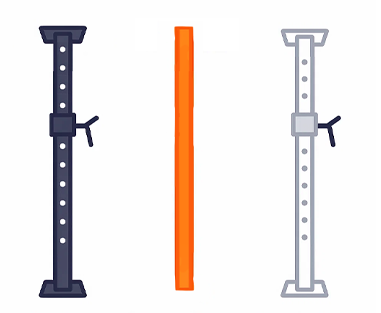
The most frequently chosen ceiling formworks – which type should you choose for your construction?
The most frequently chosen ceiling formwork is a key element of every construction site, which affects both the pace of work and the quality of construction. Choosing the right type formwork depends on the specifics of the investment, the type of ceiling, and the expectations regarding the durability and cost-effectiveness of the solution. Various systems are available on the market – from traditional wooden to modern steel and aluminum formwork – and each has its own advantages and applications. Therefore, it's worth carefully analyzing which type of ceiling formwork will work best for your construction project to ensure that work runs smoothly and without unnecessary costs.
Wooden ceiling formwork
This is the most traditional solution, which is still widely used in smaller constructions and where low material prices are important. Wooden formwork consists mainly of boards and props, which create a simple but stable structure supporting the concrete until it sets. Their major advantage is easy availability and the ability to adapt to non-standard ceiling dimensions. The disadvantage, however, is their shorter durability and the need for frequent replacement of elements, as wood wears out quickly. Despite this, for many individual investors, it is the cheapest and easiest way to create formwork.
Steel Ceiling Formwork
Steel formwork is the choice for those who value exceptional durability and repeated use. Thanks to its galvanized or painted steel construction, it is resistant to mechanical damage and weather conditions. It has a high load-bearing capacity, allowing it to be used in even the most demanding investments, such as multi-story buildings or industrial facilities. A disadvantage of steel formwork may be its greater weight, which requires the use of additional equipment during assembly and disassembly. Nevertheless, in the long run, investing in a steel system can be very profitable, especially for construction companies carrying out many projects.
Aluminum Ceiling Formwork
Aluminum formwork systems are gaining popularity thanks to their combination of lightness and strength. Aluminum is a corrosion-resistant material, which extends the life of the entire system, while being significantly lighter than steel. This means assembly and disassembly can be performed faster, often without the need for heavy equipment. Aluminum formwork is ideal for construction sites where the dynamics of work and the ability to easily transport elements between stages of the investment are important. The disadvantage may be a higher initial price, but in practice it is compensated by longevity and time savings.

Criteria for selecting formwork panels
Material type and load: wooden boards are suitable for smaller ceilings and lightweight structures, plywood boards are suitable for medium and larger projects, and plastic or PVC boards are ideal for repetitive projects requiring durability and waterproofing.
Durability and reusability: Wooden boards have a limited durability and are mainly suitable for short-term use, plywood is stable and can be used repeatedly, and PVC or composite boards are highly resistant to water, chemicals and damage, which allows for repeated use.
Assembly and transport: Light wooden and plastic boards are easy to transport and assemble, plywood is heavier but stable and precise when fitting to structural elements.
Cost and economics: wooden boards are the cheapest, PVC boards are slightly more expensive, plywood has the highest price, but ensures durability and the possibility of repeated use.
Thanks to properly selected formwork boards it is possible to quickly, safely and precisely construct concrete structures, minimizing the risk of damage and increasing work efficiency. Each type of board – wooden, plywood, steel, aluminum or plastic – has its strengths and weaknesses, and the decision to use them should be based on an analysis of loads, operating conditions, frequency of use, and the investor's aesthetic and budget requirements.
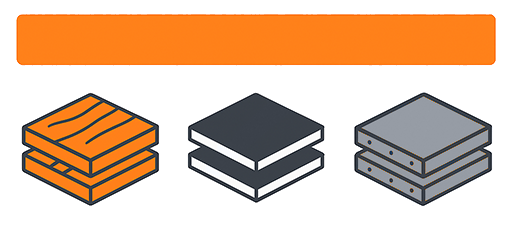
Types of formwork boards – an overview of available options
Formwork panels are one of the most important elements of formwork systems used in the construction of ceilings, foundations, and other concrete structures. Their primary function is to provide even support for freshly poured concrete, maintain the form's shape, and transfer loads to supports or ceiling girders. Selecting the appropriate formwork boards is crucial for both construction safety and economical project implementation, as the boards must withstand the weight of wet concrete while allowing for quick assembly and disassembly.
Wooden Boards
-
Usually made of pine or spruce wood, sometimes covered with a thin layer of laminate.
-
Valued for ease of processing and low price.
-
Ideal for smaller investments or unusual ceiling shapes.
-
The disadvantage is limited durability after repeated use and susceptibility to deformation and moisture.
Plywood Boards
-
A layered structure of glued wood, often with a laminated coating for greater moisture resistance.
-
They allow you to obtain a smooth concrete surface, reducing the need for subsequent processing.
-
Dimensionally stable, they enable precise fit to structural elements.
-
More durable than wood and reusable.
Plastic and composite sheets
-
They combine lightness with resistance to water, chemicals and mechanical damage.
-
Fully waterproof and resistant to rotting and cracking.
-
Smooth concrete surface, quick assembly and disassembly, modular design.
-
Higher cost compared to wood or plywood, but ideal for repeating projects.

What is a formwork head and what is it used for?
A formwork head is a metal element mounted on top of a ceiling support, which stably supports the girders and formwork panels during concrete pouring. It ensures the ceiling maintains its proper shape and evenly transfers the weight of the fresh concrete to the supports, preventing deformation and cracking. In practice, the heads enable precise positioning of ceiling beams and easy adaptation to various structural arrangements. Some models are height-adjustable or can be rotated at a specific angle, which is useful for non-standard projects. Formwork heads are reusable, which helps reduce material costs and speeds up construction work. Choosing the right type of head affects both the safety of the structure and the efficiency of the entire slab pouring process.
Cross head with angle bracket 20 cm
Cross Head with Angle Bracket The 20 cm cross head allows for the positioning of two girders simultaneously, which is useful for corner ceilings and ceiling connections. The special shape of the angle bracket allows for 90° rotation, making it easier to align formwork elements without additional supports. It is durable, reusable, and improves assembly speed.
Cross head on bars
The cross head, also known as the ceiling head, consists of a pin, a support plate, and four bars. The universal fork spacing makes the heads fit all girders. The head is load-resistant, reusable and increases the efficiency of ceiling works.
Transition/auxiliary head
Transition head, consists of a pin and a support plate. Its shape allows you to slide the head along the length of the entire joist.
Cross head on a threaded rod (adjustable)
Adjustable cross head on a threaded rod allows for precise adjustment of the height and angle of the girders. It's particularly useful for ceilings of varying thicknesses or on uneven surfaces. Reusable, durable, and reliable, it improves the safety and speed of ceiling installation.
For standard ceilings, the best solution is cross heads on rods, which allow for fine height adjustment. If you need corner connections or inserting two girders at the same time, choose Angle heads 20 cm. Adjustable heads on a threaded rod will work in more difficult conditions and on uneven surfaces, while auxiliary (transition) heads will facilitate the connection of girders of different dimensions or unusual configurations. All types are durable and reusable, which speeds up work and increases safety.
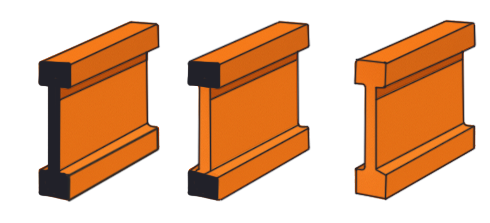
H20 formwork beams – applications and types in construction
H20 beams in formwork systems function as the main load-bearing elements, transferring loads from ceiling slabs on supports. Thanks to them, the ceiling maintains stability and rigidity during the pouring of concrete, which protects the structure against deformation and damage. The high strength of the wood and precise fit to the formwork system allow for safe assembly, and the durability of the girders allows for repeated use in various construction projects. H20 beams are available in several variants: without fittings, with fittings, and fully fitted, allowing them to be tailored to the nature of the investment, intensity of use, and required strength. The right choice of girder type affects not only the safety of the ceiling, but also the efficiency of work on the construction site and cost optimization.
H20 beams fully ferruled
The fully fitted version has the entire beam protected with a special material, which significantly increases resistance to cracking and delamination. They are durable, reliable, and ideal for heavy-duty projects where maximum strength and structural safety are essential.
H20 beams with fittings
Beams with fittings have only the beam ends reinforced, which protects the wood from mechanical damage during transport and assembly. This is a compromise between strength and cost, suitable for most standard construction applications.
H20 beams without fittings
The simplest and cheapest version of H20 beams, light and functional, but more susceptible to mechanical damage. Recommended for smaller investments or where loads are not high.
H20 Beam Lengths
Girders are available in many lengths, from 1.90 m to 5.90 m, which allows them to be adapted to various formwork arrangements and ceiling sizes. Optimal length selection facilitates work organization and minimizes the number of props on the construction site.

Formwork props – reliable support for the structure
Formwork props are an essential element when constructing reinforced concrete ceilings. Their task is to temporarily support the formwork and take the weight of the freshly poured concrete until the structure reaches the required strength. They keep the formwork in the correct position, ensuring safety and precision during concreting. Props are divided into various types, most often Italian, Spanish, and German.
Spanish type Prop 10-8kN
Spanish type is an economical solution for temporarily supporting reinforced concrete ceilings. With a load capacity of 8–10 kN, it is suitable for less demanding ceilings, ensures formwork stability and safety during concreting. It is easy to install and adjust and is the cheapest choice for simpler structures.
| Available spacing: |
| 0.60-1.10m |
| 0.80-1.40m |
| 1.00-1.80m |
| 1.60-2.90m |
| 1.80-3.20m |
| 2.00-3.60m |
| 2.20-4.00m |
Italian type support 10kN
Italian type is a light and handy prop with a load capacity of 10 kN - intended for ceilings with moderate loads, often used on small and medium-sized construction sites. Easy to install and adjust, it is an economical solution where a higher load capacity is needed than in the lightest models.
| Available spacing: |
| 0.60-1.10m |
| 1.80-3.20m |
| 2.00-3.60m |
| 2.20-4.00m |
| 2.40-4.50m |
| 2.80-5.00m |
German type support 20-14kN
German Type is a solid, industrial prop designed for heavier ceilings. It has a strong construction and thicker walls, which translates into a long service life even under intensive use. The adjustment thread is located on the outside, which facilitates adjustment and reduces wear of the components. The highest load capacity is achieved at the lowest setting - as the support lengthens, the load capacity decreases.
| Available spacing: |
| 1.00-1.80m |
| 1.60-2.90m |
| 1.80-3.20m |
| 2.00-3.60m |
| 2.40-4.50m |
| 2.80-5.00m |

Interpretation of support capacity
The load capacity of props is given in kN (kiloNewtons) – 1 kN is approximately 100 kg of weight. For example, supports with a load capacity of 8 kN will props approximately 800 kg, and those with a load capacity of 20 kN – approximately 2 tons. In the case of props whose load capacity varies depending on the setting, the greatest load capacity occurs at the lowest position, and decreases as it is extended. An example is German prop in the range 1.80–2.90 m, the load capacity of which is 20 kN at 1.80 m and 14 kN at 2.90 m, with intermediate values varying proportionally.
Choosing the appropriate props for the investment and ceiling height is crucial for the safety and efficiency of construction. Proper props ensure formwork stability and load transfer in accordance with standards, minimizing the risk of deformation or damage to fresh concrete. By matching the load-bearing capacity and length of the supports, you can optimally utilize the material, avoiding excessive costs associated with oversizing or damage. Well-selected props also speed up the assembly and disassembly of the system, which improves workflow and shortens the project implementation time.


 Log in with Facebook
 Log in with Google